
Religion is Not an Important Source of Identity For Many Americans
Featured Data January 21, 2022

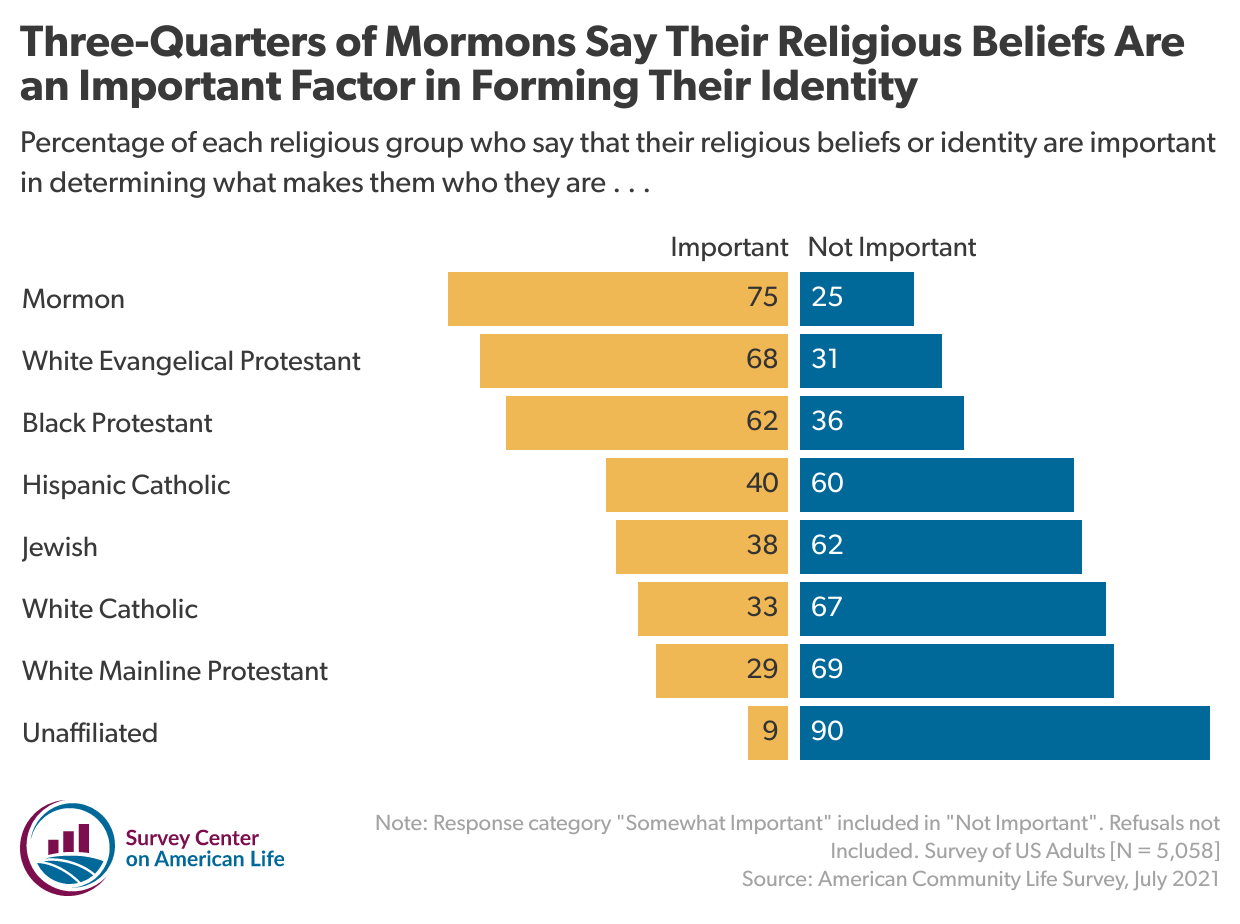
Chart showing percentage of each religious group who say that their religious beliefs or identity are important in determining what makes them who they are

Despite recent trends documenting an overall decline in religious belief, practice, and affiliation, most Americans still identify with a particular religious tradition. But surprisingly, a significant number of religious Americans say their religious beliefs or identity are not central to who they are. A majority of both White (67 percent) and Hispanic (60 percent) Catholics, white mainline Protestants (69 percent), and Jewish Americans (62 percent) say religion is not an important part of their identity. In contrast, three-quarters (75 percent) of Mormons and a majority of White evangelical Protestants (68 percent) and Black Protestants (62 percent) say their religious beliefs are an important part of their identity. Mormons stand out not only for their strong religious identities, but also for their unique attachment to their communities. This may help explain why so many members of the LDS Church say their religious identity is so important.

Generation Uncoupled

Generation Uncoupled book

Generation Uncoupled: America's New Gender Divide and the Crisis of Human Connection

Buy Now

Survey Reports

Daniel A. Cox
July 23, 2026

A Digital Divide in American Adolescence: Gender, Class, and the New Teenage Experience

If teenage years once represented a time of rebellion, teenagers’ lives today are marked less by pushing boundaries and more by building their own. Many teenage experiences are less common than they once were—dating, working a part-time job, and experimenting with drugs and alcohol are less common experiences. The 2026 American Teenagers Survey from the

Daniel A. Cox, Jae Grace, Avery Shields
April 27, 2026

Strangers Next Door: The Decline of Neighborhood Socializing and the Class Divide in Belonging

Acknowledgment The American Enterprise Institute’s Survey Center on American Life is grateful to the John S. and James L. Knight Foundation for its generous support of this research. As Americans spend more of their time online, the neighborhood—once a primary physical location for real-world socialization—is playing less of a central role than ever before. Since