
Religious Disaffiliation and Loneliness
Featured Data March 29, 2022

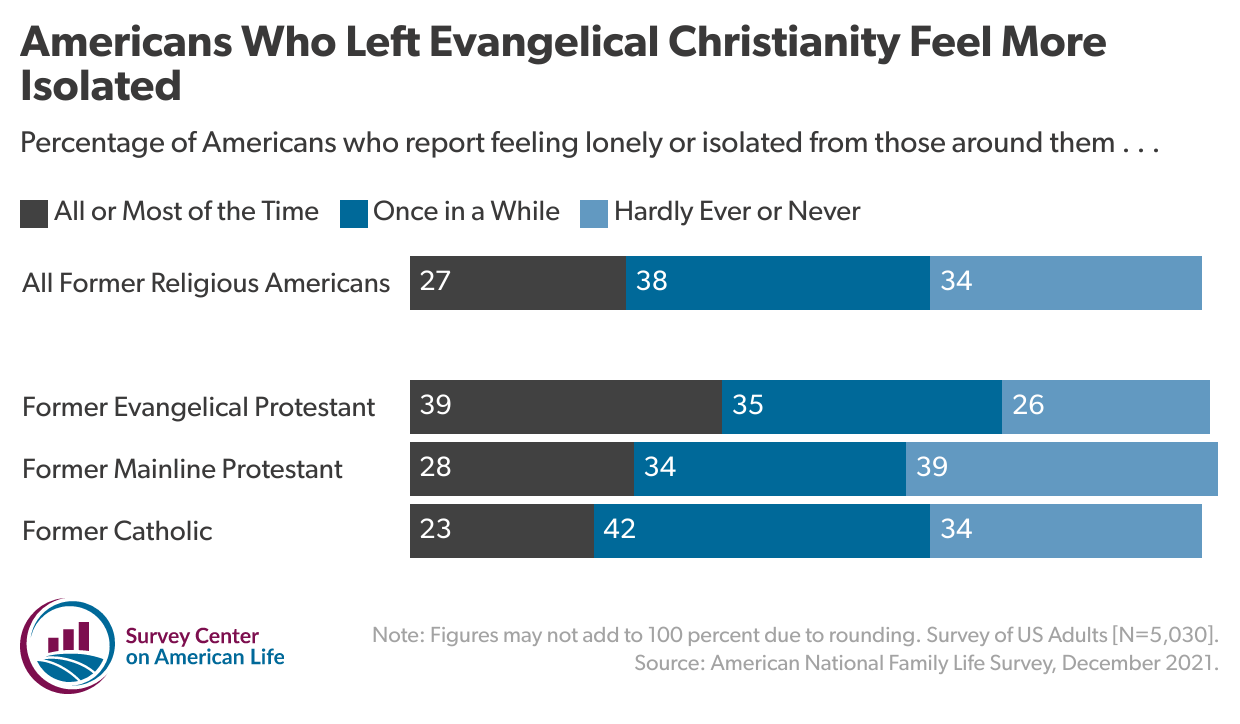
Chart showing percentage of Americans who report feeling lonely or isolated from those around them. Options are all of the time, once in a while, and hardly ever. The respondents are former evangelical protestants, former mainline protestant, and former catholics.

The act of leaving religion can be difficult. Americans who leave their childhood religion report more acute feelings of social isolation and disconnection. This is especially true for those who disaffiliate from more conservative faith traditions. Nearly four in 10 (39 percent) former evangelical Protestants report feeling lonely or isolated from those around them all or most of the time. Significantly fewer former mainline Protestants (28 percent) and former Catholics (23 percent) say the same. This may be because leaving a religious community often results in severing important social ties and shredding systems of support. Past research has shown that members of conservative religious traditions often organize more of their social life through their church or place of worship. Given that many if not most of the people they know belong to the same place of worship, it’s not hard to see why leaving religion can result in increased feelings of social isolation and loneliness. 

Generation Uncoupled

Generation Uncoupled book

Generation Uncoupled: America's New Gender Divide and the Crisis of Human Connection

Buy Now

Survey Reports

Daniel A. Cox
July 23, 2026

A Digital Divide in American Adolescence: Gender, Class, and the New Teenage Experience

If teenage years once represented a time of rebellion, teenagers’ lives today are marked less by pushing boundaries and more by building their own. Many teenage experiences are less common than they once were—dating, working a part-time job, and experimenting with drugs and alcohol are less common experiences. The 2026 American Teenagers Survey from the

Daniel A. Cox, Jae Grace, Avery Shields
April 27, 2026

Strangers Next Door: The Decline of Neighborhood Socializing and the Class Divide in Belonging

Acknowledgment The American Enterprise Institute’s Survey Center on American Life is grateful to the John S. and James L. Knight Foundation for its generous support of this research. As Americans spend more of their time online, the neighborhood—once a primary physical location for real-world socialization—is playing less of a central role than ever before. Since